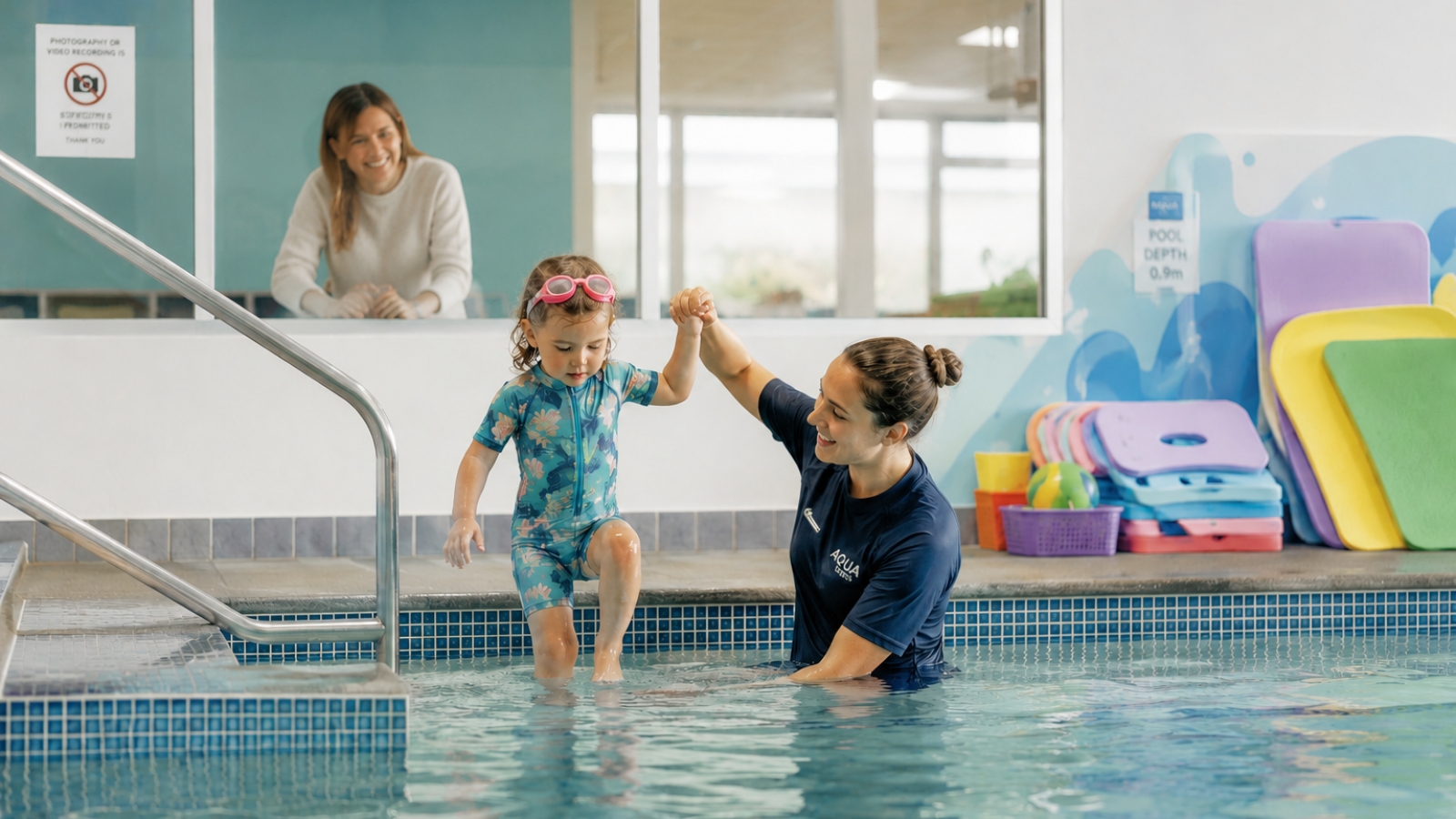
You've booked the first lesson, and now you're picturing two outcomes: a happy splash-about, or a screaming toddler clinging to your leg at the pool edge. Most first lessons land somewhere in between, and a little preparation at home makes the happy end far more likely.
Key takeaways
- Water confidence starts in the bath, not at the pool — pouring, blowing bubbles and gentle face-wetting all help.
- Pack for the whole visit, not just the lesson: swimwear, a towel, goggles if used, a warm layer and a snack for afterwards.
- Arrive with time up your sleeve. A rushed changing room is where most pre-lesson meltdowns start.
- Tears in the first lesson or two are normal and usually settle — instructors see this every day.
- Ask the swim school about their class ratios, water temperature for young children, and what happens if your child is upset, before you commit.
How young can my child start swim lessons?
Swim schools around New Zealand generally take babies from a few months old through to teens, and most offer separate class types for babies, toddlers and school-age children with no prior experience. The right starting age for your child depends on their comfort around water and your own goals — early water familiarisation versus learning to swim independently are different things. [VERIFY: recommended starting age for swim lessons per Water Safety NZ or Swimming NZ guidance] For general water safety guidance for young children, Water Safety New Zealand is a good primary source to check before you book.
How do I build water confidence before the first lesson?
You don't need a pool to start this work — the bath does most of it.
- Make bath time playful: pouring water from cups, blowing bubbles, splashing gently.
- Practise water on the face in small doses — a wet flannel, then a gentle pour over the forehead — rather than a surprise dunk.
- Let your child put their own face in a basin of water if they're keen, on their terms, with no pressure to go further than they want.
- Talk about the pool positively and specifically: what the water will feel like, that the instructor will be friendly, that you'll be nearby.
- If you can, visit the pool as a spectator before the first lesson so it's not a completely new environment on the day.
If your child is already anxious about water, don't force face-dunking or nose-holding drills at home — that's the instructor's job, and rushing it can set confidence back. Simple, low-key play is enough groundwork.
What should I pack for the first lesson?
Pack for the whole visit, not just the 20-30 minutes in the water.
- Togs/swimwear that fit well — baggy trunks or a loose costume can knock a young child's confidence when they feel like they're falling out of their clothes.
- A swim nappy if your child isn't yet toilet trained; most pools require this and won't accept a regular nappy in the water [VERIFY: swim nappy requirement and any pool-specific rules].
- Goggles, only if your child's class uses them — some beginner classes deliberately skip goggles so kids get used to open eyes underwater.
- A large towel and a warm layer for after, since pool complexes can feel cold once wet.
- A change of clothes and a plastic bag for wet things.
- A small snack for the car or changing room — lessons often run close to nap or dinner time, and a hungry, tired child is a harder sell on "let's go swimming."
What actually happens in a first lesson?
Most beginner classes are short, playful and instructor-led rather than formal "learn to swim" drilling. Expect songs, toys, floating games and lots of praise rather than laps. Class sizes and instructor-to-child ratios vary by swim school and by age group [VERIFY: typical class size / ratio for beginner swim classes], so it's worth asking directly when you enrol. Ask too about water temperature for young or nervous swimmers, whether parents get in the water for the younger age groups, and what the plan is if a child becomes distressed mid-lesson.
How do I handle tears or fear on the day?
Crying at a first swim lesson is common and doesn't mean your child hates the water or that you've made a mistake booking them in. New environment, new adult giving instructions, and water on the face all at once is a lot for a small child to process in one go.
- Stay calm and matter-of-fact rather than anxious or overly reassuring — kids pick up on your tone.
- Avoid bribing with treats before the lesson starts; save any reward for afterwards, as a "well done for trying," not a condition.
- Give it three or four sessions before deciding it's not working. Confidence usually builds once the routine becomes familiar.
- Talk to the instructor if the crying doesn't ease — a good swim teacher will adjust their approach for a nervous child rather than push through.
- If your child is genuinely distressed rather than just unsettled, it's fine to step back, sit it out for a week, and try again once they're a bit older.
Is my child too old or too young to start?
There's no upper age limit — plenty of children start lessons at school age with no prior swimming, and swim schools run beginner classes for older kids that don't assume any water experience. On the younger end, water familiarisation classes exist for babies well before independent swimming is realistic; these are about comfort and safety reflexes rather than "swimming" in the technical sense. If you're unsure which class level fits your child, call the swim school and describe your child's current comfort with water rather than just their age — most will place based on ability, not birthdate.
What if my child has never had water on their face?
This is one of the most common reasons parents delay lessons, and it's fixable with patient, low-pressure practice rather than a single big push. Build up gradually at bath time using the steps above, and let the instructor know at enrolment so they can pace the first few lessons accordingly. Some swim schools offer a shorter "settle-in" trial lesson for exactly this situation — worth asking about if your child is particularly anxious.
Swimming is one of many activities worth trying in these early years, and if you're weighing it up alongside other options, our guide to choosing an after-school activity your child will actually stick with covers how to tell a good fit from a bad one before you commit to a term's fees. On rainy weeks when the pool trip gets cancelled, rainy-day activities for toddlers can keep the water-play momentum going at home.
What's a good next step?
Once you've got the basics sorted at home, the practical part is finding a swim school near you with a class that matches your child's age and comfort level. Browse kids' activities including swim schools in your area to compare class types, ages and timing before you book that first lesson.
FAQ
My child screams every time water touches their face — should I still take them to lessons?
Yes, but go in with realistic expectations for the first few sessions. A good instructor is used to working with nervous children and will pace things gently rather than force face-dunking on day one. Keep practising short, low-pressure face-wetting at home in the meantime, and flag the sensitivity with the swim school when you enrol.
Do I need to get in the pool with my child?
This depends on their age and the class type — many baby and toddler classes are "parent and child" by design, while classes for older preschoolers and school-age kids are usually instructor-led with parents watching poolside. Check this when booking, since it affects what you'll need to bring (your own togs included).
What if my child cries through the whole first lesson?
It's common, and one bad lesson doesn't predict the rest of the term. Talk to the instructor afterwards about what they noticed and whether they'd suggest any changes. Give it three or four sessions before deciding the timing isn't right — most kids settle once the routine feels familiar.
How soon before the lesson should we arrive?
Aim to arrive with enough time to park, get changed and use the toilet without rushing — a stressed changing room is one of the most common triggers for pre-lesson meltdowns. Arriving five to ten minutes early with nothing to do but wait calmly tends to work better than cutting it fine.